October 16, 2026
Shariah-Compliant M&A vs Conventional Buyouts
A conventional buyer starts an M&A with one question – “How much can I borrow?” Debt is king, cash flow pays the loan, and the lender earns from the interest.
Under Islamic finance principles, a compliant buyer cannot start here. Money is not a commodity you rent at interest. The return has to be earned through ownership, trade, or shared risk.
So, the question changes. It moves to “How do I build this so the return is tied to the asset itself?” The goal is the same – buying the company. However, the foundation is different. One rents capital and the other structures ownership.
That difference is why Islamic finance deal structuring is not about loaning money. It’s about the deal and how it can go from forbidden to permissible.
Return Must Follow Risk
The principle behind everything is Ghunm bil Ghurm. It means that “profit comes with liability”.
A conventional lender is built to avoid exactly that. They offer secure, compounding loans where they are first in line if the business fails.
Compliant structures cannot break the link between return and risk. Whoever provides the capital needs to carry some downside.
Murabaha vs Musharaka
Both Murabaha and Musharaka replace interest with something permissible, but they do it differently.
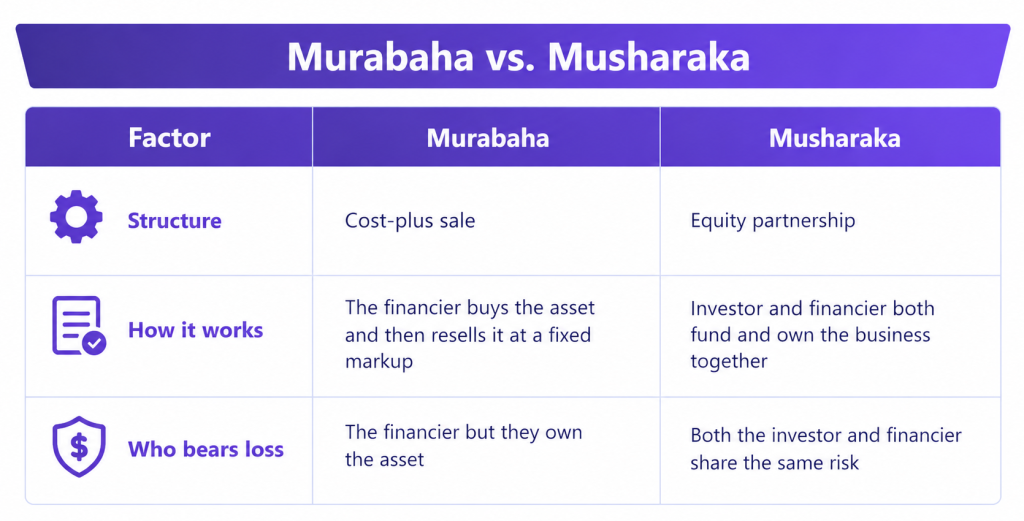
Murabaha makes debt-free business acquisitions possible. The buyer still pays over time, but what they pay with is trade profit, not riba (interest).
Default Without Compounding
With Islamic financing, many question what happens if a payment is missed. In this circumstance, a late fee will occur, but this is used only to cover genuine administrative costs. Anything beyond that cannot be kept, and it goes to charity as nobody can profit from another person’s distress.
T he Sukuk Paradox
So, if both systems exchange capital and generate returns, isn’t Islamic finance just conventional finance, but just relabeled?
That’s where Sukuk comes into play. A conventional bond is a loan. Interest and the principal of a loan are paid regardless of performance. A Sukuk is not.
AAOIFI, the industry’s standard-setter for Islamic finance, defines it as an undivided ownership share in a real asset. The holder earns from what it produces, and if the asset loses value, so does the Sukuk.
Sukuk vs conventional bonds come down to one thing. Same capital raised, same return possible, but an entirely different instrument. That’s because the structure moves it from an exchange of debt to an exchange of ownership.
Same Materials, Different Structure
The same bricks build a wall or bridge. Capital and trade are no different. What separates a permissible deal from a forbidden one is where ownership sits, who carries the risk, and how the return flows.
If you are structuring a Shariah-compliant M&A deal, feel free to reach out to OCX Advisors today. Our team will be more than happy to provide you with a clear roadmap on how to turn a forbidden deal into a permissible one.
About Post
